Buying Intelligently in Villa Park: What Comes With a Half-Acre Estate, and What Doesn’t
Thomas Real Estate Group has lived in Villa Park for decades and sold homes here for more than forty years, and in that time the same conversation has come up with hundreds of families moving in from newer neighborhoods. It always starts the same way: they love the house, they love the lot, and they are a little surprised by the first summer’s bills. This is that conversation, written down. Buying intelligently here means knowing what comes with a half-acre estate, and what does not, before you make an offer. None of it should talk anyone out of a home in Villa Park. It should simply let you buy one with your eyes open.
The two things that change the math
Everyone expects a bigger house to cost more to run, and it does. Most Villa Park homes are somewhere between the high 2,000s and 7,000 square feet, so electricity, gas and water all trend up with the size. That part is logical and nobody is caught off guard by it.
What catches people is not the size. It is two other things:
- The age of the house. Most of Villa Park was built in the 1960s and 70s. Fifty- and sixty-year-old homes have a character that newer construction cannot copy, and they also have the insulation, windows and mechanical systems of their era unless someone has replaced them.
- The size of the lot. A typical Villa Park lot is half an acre or more, and most of that is lawn, mature trees and shrubbery that need water and care. A 5,000-square-foot lot in a newer development has none of this.
This article is about Villa Park because it is home, but the same math applies to any neighborhood with the same profile: homes from the 60s and 70s on sprawling lots. North Tustin and Cowan Heights, Orange Park Acres, and the estate pockets of Anaheim Hills and Yorba Linda all follow the same rules. If you are moving from a newer tract home to any of them, read on.
The house: energy and upkeep
Why the electric bill is not a simple multiplication
People tend to budget energy by scaling up from their last home: twice the square footage, roughly twice the bill. In an older house it does not work that way. Even a beautifully renovated Villa Park home often still has its original insulation, older windows, no radiant barrier under the roof, and an air conditioner that works fine but was never efficient. Each of those adds a little, and together they can make the summer bill climb faster than the square footage alone would suggest.
Across the homes we sell and the families we stay in touch with, these are realistic ranges for a home without solar:
| Electricity (no solar) | Cooler months | Summer months |
|---|---|---|
| Smaller Villa Park home (high 2,000s to 3,500 sq ft) | $200 – $450 | $600 – $900 |
| Larger home (4,000 to 7,000 sq ft) | $300 – $600 | $1,500 – $1,800 |
Gas and household water are less affected by the age of the house. They scale with use about the way they would anywhere else: figure $100 to $250 a month for gas, and $200 to $400 a month of household water in a smaller home, $300 to $500 in a larger one. Irrigation is a separate bill that belongs to the lot, and comes up below.
Solar changes this picture considerably, and at these summer numbers it deserves its own conversation. That is a separate article coming soon.
Upkeep on a home with some history
An older home simply asks for more attention than a new one. Original plumbing and electrical, exterior siding, older windows and aging air conditioning all need a little more care, a little more often. Most of it is ordinary: a plumber here, a service call there, a window that needs resealing. The big-ticket mechanical items, the roof, the sewer line, the panel, the HVAC, are their own subject and a future article will go through which upgrades pay off and what they cost. For budgeting purposes, the sensible approach is a monthly reserve, and it has its own line in the table below.
The pool
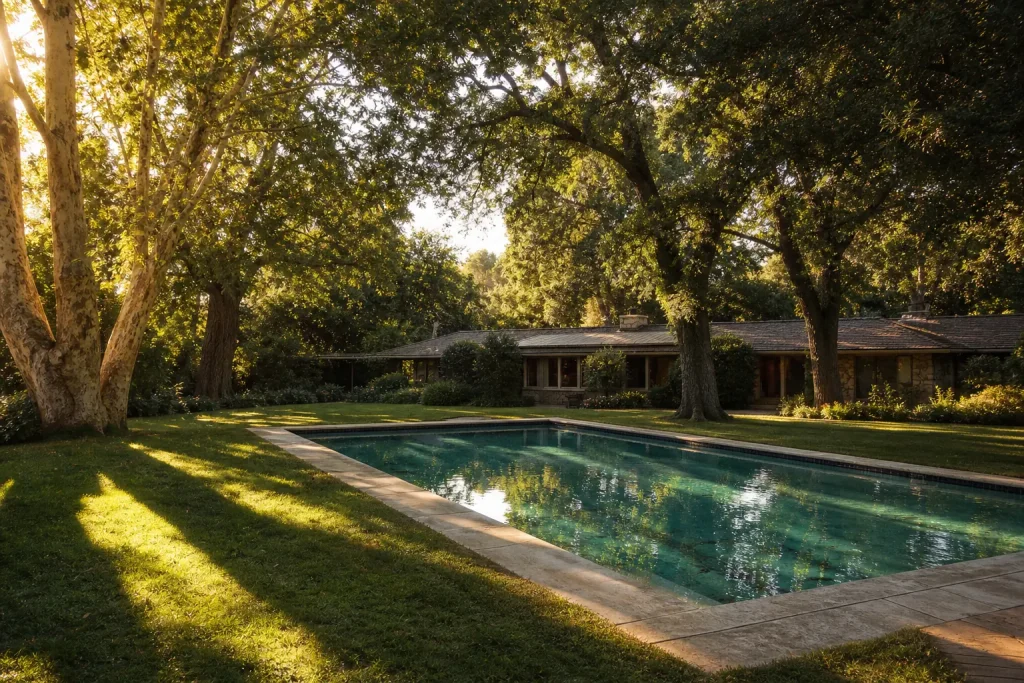
Most Villa Park pools were built with the house or shortly after. That means deep ends of seven or eight feet, which almost nobody builds anymore, along with the plaster, plumbing and equipment of that era unless they have been updated. Two numbers to know:
- Running it: figure $75 to $150 a month in additional electricity for the pump and filter, and $150 to $300 a month for service. Our pools are large, deep and usually surrounded by big trees that shed into them, which makes the service a real job.
- Renovating it: bringing an original pool up to a current standard, with new plaster, plumbing and equipment, runs anywhere from $30,000 to well over $100,000 depending on scope. Not a monthly cost, but worth knowing when you look at a home with a pool that has never been redone.
The lot: where the real difference lives
This is the part almost nobody coming from a newer neighborhood has budgeted for, because they have never had to. A Villa Park lot means 12,000 to 20,000 square feet of living things: lawn, mature trees, shrubbery and the irrigation that keeps all of it healthy.
- Gardening. Regular service on a lot this size runs $300 to as much as $1,000 a month, depending on the property and the level of care. That is before sprinkler repairs, fertilizing and the other things that fall outside a standard service.
- Water. Irrigating half an acre of lawn and mature landscape is a different bill than watering a small yard. Expect the water bill to be noticeably higher than anything you paid on a 4,000- to 6,000-square-foot lot, and highest in summer.
The one almost nobody sees coming
Tree trimming. Mature trees are a big part of what makes Villa Park feel the way it does, and keeping them healthy and manicured is real work. On a lot this size, professional trimming runs $2,000 to $10,000 every year or two. In a newer development the trees are small and young and this expense barely exists, so it is the one line that genuinely surprises people. Budget for it from day one and it is just part of owning a beautiful property.
What does not come with it
Two lines you will not find in the budget below
No HOA. No Mello-Roos. Villa Park has no homeowners’ association, and no Mello-Roos community facilities district adding a developer-era tax to the property bill. (Like every California city, Villa Park does have ordinary voter-approved items on the tax bill, such as school bonds; those are modest and are not what people mean by Mello-Roos.) In many newer Orange County communities, HOA dues and Mello-Roos together run several hundred dollars a month, every month, for decades, and buy you a set of rules about your own property. Here, that money goes into your own trees, your own pool and your own home, and the decisions are yours.
Long-time owners also enjoy Proposition 13 keeping their tax base low, and, since 2021, the ability to take it with them when they move. We wrote about that here.
Putting it together: a monthly budget beyond the mortgage
Here is how it adds up for a typical Villa Park estate, call it 4,000 square feet on a half acre with a pool, without solar. These are ranges from experience, not quotes, and every home is different. The middle column is where most owners actually land; the upper end assumes the biggest house, the fullest service and the largest trees all at once, which almost no single property does. Property taxes, insurance and the mortgage itself are not included; this is the “everything else.”
| Monthly, beyond the mortgage | Lower end | Typical | Upper end |
|---|---|---|---|
| Electricity (averaged across the year) | $500 | $700 | $1,100 |
| Gas | $100 | $150 | $250 |
| Household water (smaller homes $200–400; larger $300–500) | $200 | $300 | $500 |
| Irrigation water (large lot) | $150 | $250 | $400 |
| Gardening service | $300 | $500 | $1,000 |
| Landscape extras (sprinklers, fertilizing, plantings) | $100 | $150 | $300 |
| Tree trimming, set aside monthly | $100 | $300 | $800 |
| Pool service | $150 | $200 | $300 |
| Pool electricity | $75 | $100 | $150 |
| Home maintenance reserve (older home) | $1,000 | $1,500 | $2,500 |
| Total | about $2,700 | about $4,200 | about $7,300 |
A quick word on that last line. For an older home, a maintenance reserve of around 1% of the home’s value per year is a reasonable planning figure. On a $2.5 million to $3 million home that is $2,000 to $2,500 a month set aside, not spent. Many years you will not touch it. In the year the air conditioner and the roof both decide it is time, you will be glad it is there. The table shows a slightly lower range because a well-maintained home needs less, but it is not a line to go below.
In round numbers: most owners should plan on about $2,500 a month for utilities, pool and grounds, plus a maintenance reserve they will rarely touch, for a typical total near $4,200. Go in with that budget, with no HOA or Mello-Roos line to add to it, and nothing about owning here will surprise you.
What you are really buying
To be clear about the point of all this: none of it describes a problem. It describes the cost of something rare. The things that make these homes a little more expensive to keep, the mature trees, the half-acre lots, the 1960s craftsmanship, the deep pools, are the same things that make Villa Park quiet, private, low-density and beautiful, with a pride of ownership you can see from the street. You cannot build a 60-year-old oak, and a half acre in a new development comes with young trees, a homeowners’ association and neighbors on the same schedule. A half acre here comes with sixty years of canopy, no association, and a neighborhood that has looked after itself since 1962.
The families who are happiest here are the ones who bought intelligently: they understood what came with the property on day one and never had to think about it again. That is what this guide is for.
If you are considering a home in Villa Park or a neighborhood like it and want a realistic, line-by-line picture of what a specific property costs to own, contact us, call 714.998.8300, or email info@thomasrealestategroup.com. We have walked hundreds of families through it, and we are glad to walk you through it too.
Figures in this article are ranges drawn from Thomas Real Estate Group’s experience selling and living in Villa Park, rounded for planning purposes. Actual costs depend on the home, the lot, the systems and how you live. They are not quotes or estimates for any specific property.